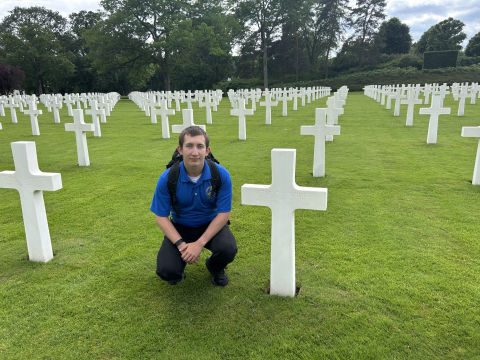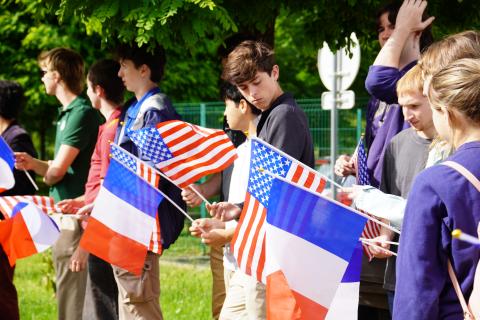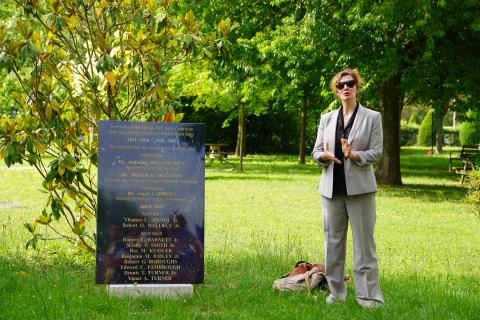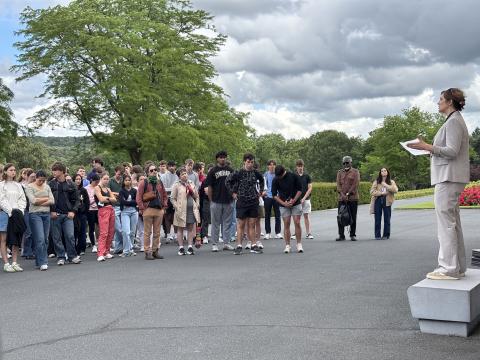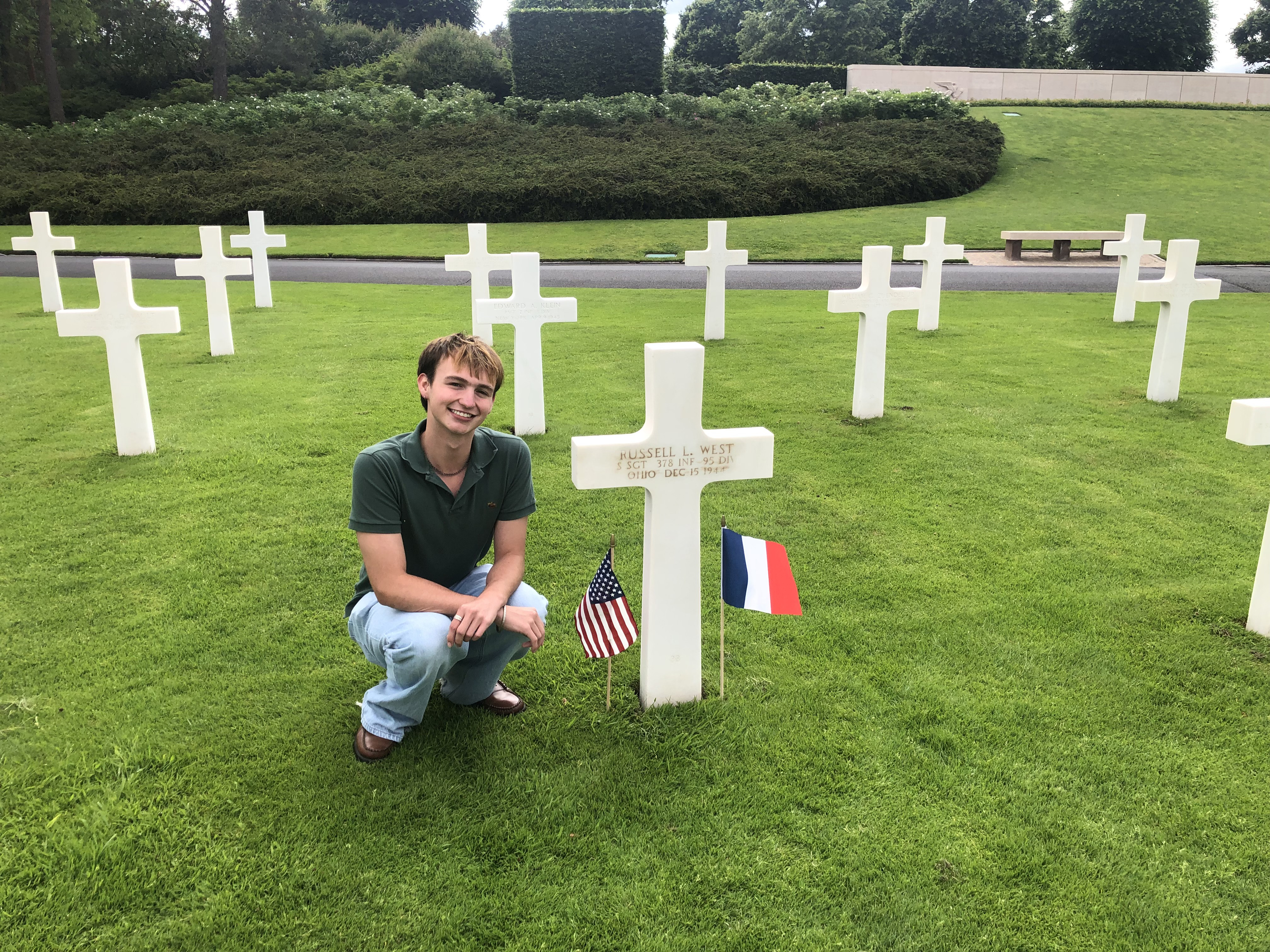
At the Lorraine American Cemetery in Saint-Avold, a Georgia Tech undergraduate laid a wreath at the headstone of the great-grandfather he never met, one of 14,246 U.S. service members buried there. Across courses led by professors Jennifer Orth-Veillon, Timothy Stoneman and Jon Beall, Georgia Tech-Europe Summer 2026 students moved beyond dates and statistics to connect with the human stories of two world wars, often uncovering their own.
Georgia Tech-Europe and University of North Georgia Partnership Connects Students to Personal and Shared Histories of World Wars I and II
SAINT-AVOLD, France. On a June afternoon at the Lorraine American Cemetery in Saint-Avold, 250 Georgia Tech-Europe (GTE) students stand looking over a field of 14,246 white marble headstones, one for each U.S. service member buried beneath. Silence surrounds the group as Matthew Ramsey, a Georgia Tech undergraduate, leans a wreath against the tombstone of his great-grandfather, Staff Sergeant Russell Wilson, an Army infantryman killed in the Battle of the Bulge. Ramsey performs the familial ceremony, rubbing sand from Omaha Beach and planting a flag in front of the headstone. "I am the first person in my family to ever get the chance to do so," he shares. Other GTE students witness the moment, connecting to a history that has shaped the world as they know it.
Exploring personal and shared world histories is central to a Georgia Tech-Europe education. Situated in one of the most contested landscapes in modern Western history, GTE offers students direct access to the trenches, forts, and cemeteries of two world wars. Courses such as Professor Timothy Stoneman’s HTS 2037: 20th-Century Europe, and portions of Professor Jennifer Orth-Veillon’s LMC 3234: Travel Writing, incorporate these sites into their curriculum. This summer, GTE partnered with the University of North Georgia on an immersive military history program featuring Professor Jon Beall’s HTS 3803: War & Leadership, Middle Ages to Present. Across these courses, students move beyond dates and statistics to engage with the human stories of history and reflect on their connections to the past.
Like Matthew Ramsey, Cadet Kyle Gallentine, a UNG cybersecurity major, reported standing in the Lorraine Cemetery brought him closer to his great-grandfather, a WWII soldier. "When I left the cemetery, I felt a strong desire to learn my family's story," Gallentine said. "We still have his uniform, campaign map, photographs, and other keepsakes, but I never truly knew the story behind them."
After the Lorraine Cemetery visit, Orth-Veillon, Stoneman, and Beall led an overnight trip to the Meuse region. Nicolas Czubak, official historian of the Verdun Memorial Museum, guided the group through the Meuse-Argonne cemetery, the Butte de Vauquois, and the Montsec Memorial before reaching Verdun itself, France's most symbolic WWI battlefield. For Peter Kobes, a mechanical engineering major, the cemetery reframed how he thought about war’s cost. "By resting at the place they fell, these soldiers let strangers like me stop and reckon with their loss," he wrote in a photo essay assigned for the trip.
The students’ second trip to Belgium carried a different weight, as it was inspired by Orth-Veillon’s own family history. Her grandfather, Dr. William J. Hagood Jr., served as a battalion surgeon with the 335th Infantry Regiment, 84th Division, during the Battle of the Bulge. Orth-Veillon interviewed him before his death in 2009 and has since drawn on an archive of over 500 of his wartime letters. That research led her to Jacques Bourguignon, 104, a former Belgian resistance fighter who sheltered Hagood's medical unit in his family's cellar in Marche-en-Famenne over Christmas 1944. "On Christmas Eve, they sheltered there with about fifty others, including neighbors, other soldiers, and even German prisoners," Orth-Veillon shares. The two men remained friends by letter until the 1960s.
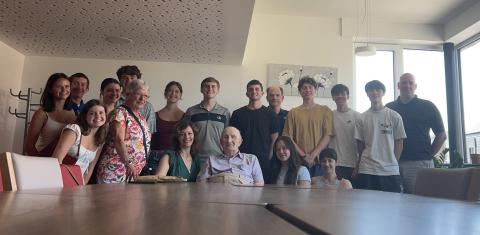
The highlight of the trip came when thirteen students from Orth-Veillon's, Stoneman's, and Beall's classes spent the morning with Jacques Bourgignon at his retirement home. Bourguignon, an active member of the Lion’s Club and current president of Marche-en-Famenne’s motorcycle club, told them the story of his life, focusing on the resistance, which he joined at age 17.
“Were you afraid during your missions?” asked the students.
“We weren’t scared,” he replied, chuckling. “We were crazy. I joined the resistance because I wanted to do something to fight back. It felt like the only human way to respond.”
“What do you want to say to people today?”
“Try to do as much good as possible in life. I am grateful to the Americans for the liberation of Belgium. After years of occupation and suffering, seeing them arrive was unforgettable.”
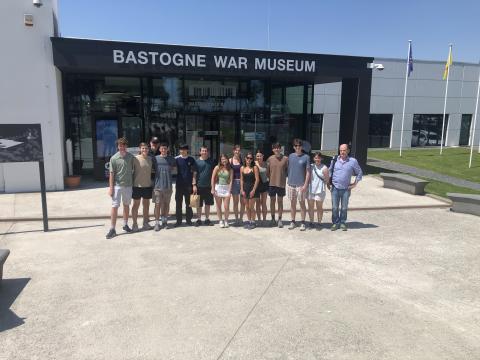
They also visited Bastogne War Museum to commemorate the Ardennes Offensive, during which 89,000 American soldiers were killed or wounded between December 1944 and January 1945. For Tucker Messer, a rising second-year business administration major, the visit brought a family story to life: his great-grandfather, Oscar Messer, fought there with the 10th Armored Division's 61st Armored Infantry Battalion. "Walking around the scene of the heavy fighting, I realized how fragile human life is and how one small thing changes history," Messer said. "If a random German teenager fighting in the battle had aimed better and killed my great-grandfather, I would not be here."
"Few academic programs place students directly inside the geography of the history they study," said Beall, who guided the group through Stavelot, a resistance stronghold during the Ardennes Offensive. Learning deepens when students stand where history happened and connect their identities to the people and events that shaped it. As Orth-Veillon, Stoneman, and Beall suggest, they leave with more than a photograph or final assignment; they carry a lasting relationship with the past that shapes how they see the world and their place within it.
Additional Images